
Completedworks
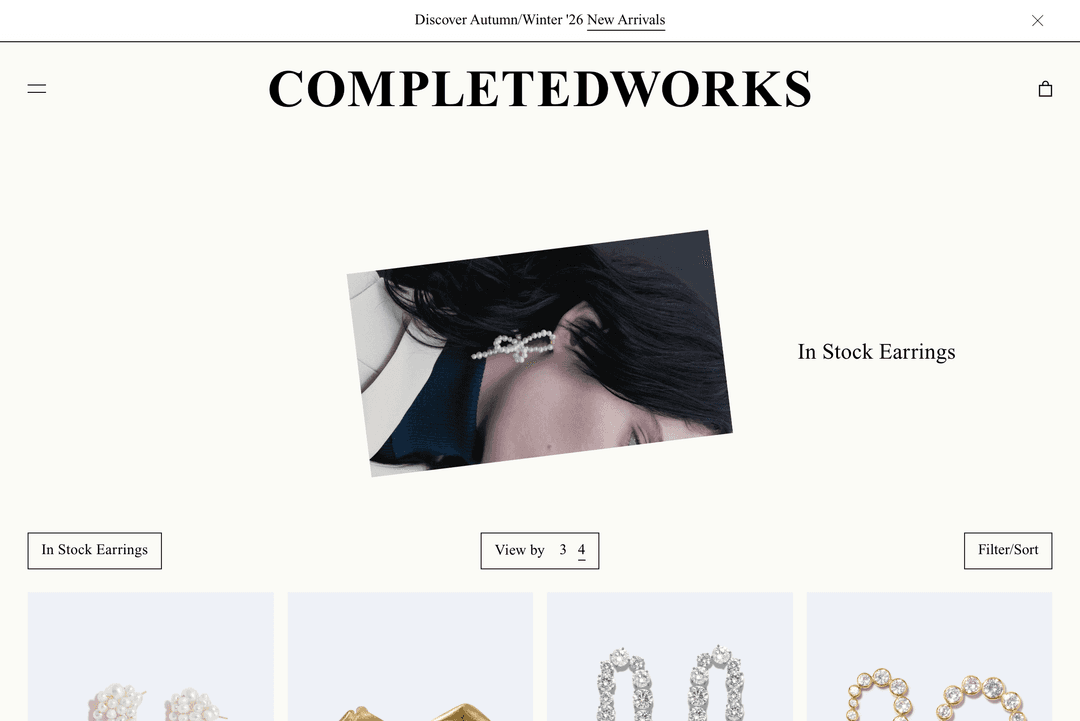
Completedworks is a London jewellery and homeware brand selling over a thousand products through Shopify. Smart-UI rebuilt the storefront on Online Store 2.0, redesigned it in the same release, and has supported it since.
Project Overview:
Completedworks sells sculptural jewellery and homeware from London, with a catalogue of more than a thousand products across several hundred collections. The store was running on a theme that predated Shopify's Online Store 2.0, which meant every change to a product or collection page went through a developer. We rebuilt the theme on 2.0 and shipped a full redesign in the same release, because the migration is a theme rebuild either way and doing both at once costs less than doing them in sequence.
Challenges:
- No upgrade path: a vintage theme cannot be converted, every template had to be rewritten as sections with schema.
- Catalogue scale: over a thousand products and several hundred collections, so every template decision is taken a thousand times.
- App integrations left as Liquid inside the old templates, each one needing an app block or a replacement we control.
- A redesign and a migration in one release, without losing URLs, redirects or search rankings.
- Flexibility that cannot cost speed: sections everywhere makes it easy to build a slower page.
Our Solution
A custom theme, built on Online Store 2.0 and connected to Git, so the storefront is a reviewable codebase rather than a browser editor on production. Content that was hardcoded in templates became section settings and metaobjects, which is what lets the client's own team build a landing page or reorder a product page without a release. Two years on, the same team still runs it.
Every Liquid template rewritten as JSON templates with sections and schema, including the header and footer as section groups.
A theme of the brand's own rather than a store theme with overrides, connected to Git so changes are reviewed and have a history.
Shipped in the same release as the migration, with the URL and redirect mapping agreed before anything went live.
Materials, care, size guides and editorial content modelled as structured data instead of HTML inside product descriptions.
Storefront apps installed as blocks rather than Liquid fragments, so an app can be removed later without archaeology.
Seasonal campaigns, platform changes and new sections, by the team that built the theme.
Process:

Audit
Inventoried every app, template and piece of hardcoded content in the old theme, because finding an app with no 2.0 block mid-migration is how timelines slip

Content modelling
Decided what becomes a section setting, what becomes a metafield and what becomes a metaobject, before any template was written

Design
A redesign built around the brand's photography, designed as sections so the team can rearrange pages without a developer

Development
The theme rebuilt on Online Store 2.0, in Git, with a performance budget held to across a catalogue of over a thousand products

QA Testing
Checkout, filtering and the redirect map tested hardest, since those are the paths that carry revenue and rankings

Support since 2024
Campaign sections, platform updates and new templates, delivered against a theme the same team knows
Let's Get Started Now!
We would love to hear from you and discuss how we can help bring your digital ideas to life. Here are the different ways you can get in touch with us.