
Fine Matter
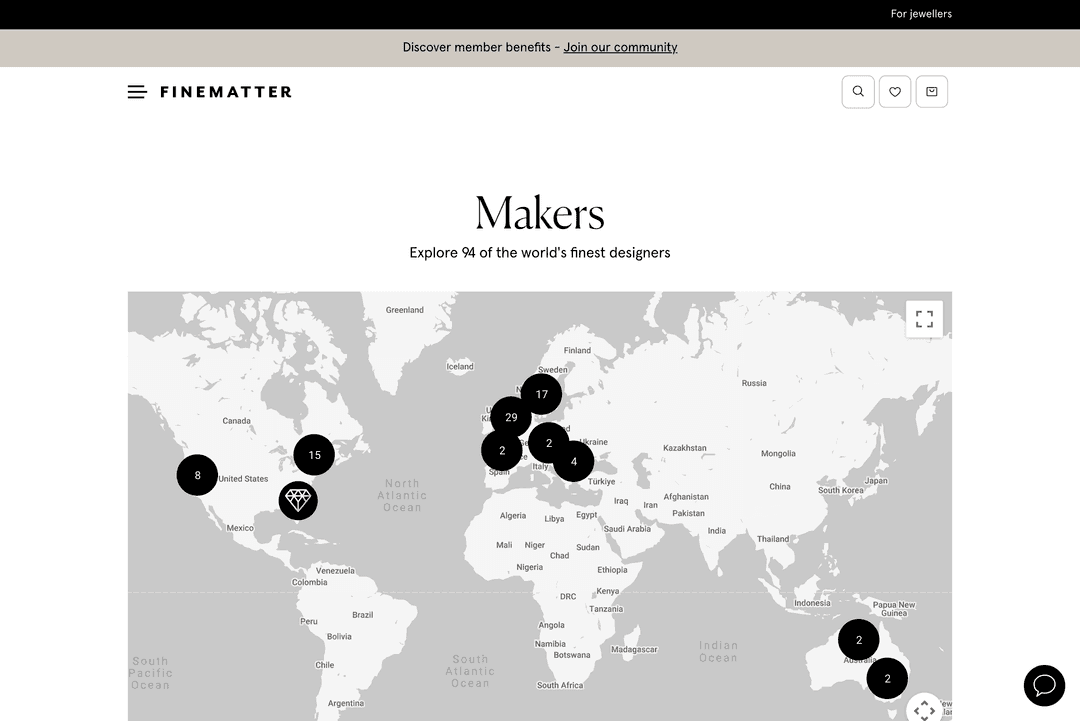
Fine Matter is a marketplace for design-led fine jewellery, bringing 94 independent makers together in one storefront. Smart-UI has built and supported the platform since 2022.
Project Overview:
Fine Matter sells fine jewellery from independent jewellers across Scandinavia, the UK, Europe, the United States and Australia. Shopify runs the commerce side: cart, checkout, payments and the order record. Everything in front of it, the browsing experience, the maker profiles and the editorial content, is a custom front end that we build and deploy independently of the commerce platform. Behind it sits a service of our own that gives each maker an account, a dashboard, sales statistics, and a way to order from the platform.
Challenges:
- Multi-vendor by design: a commerce platform built around one merchant had to serve 94 of them.
- Two sides, one system: shoppers and makers need the same data presented in completely different ways.
- Editorial alongside commerce: maker stories and guides are not products and do not belong in a product catalogue.
- Continuity: four years of platform updates, API changes and dependency churn absorbed without downtime.
Our Solution
We kept Shopify for the part Shopify is genuinely best at and built everything else ourselves. The storefront is a custom front end served from a CDN, with the editorial content in a headless CMS. The maker-facing half is a separate service with its own data model, because a multi-vendor relationship does not fit inside a single-merchant commerce platform. Four years on, the same team still runs it.
Gatsby and React, deployed behind CloudFront. The browsing experience ships on its own schedule, independent of the commerce platform.
Cart, checkout, payments, tax and the order record stay on Shopify. Rebuilding a checkout is a way to spend a year discovering why Shopify costs what it costs.
Prismic holds the editorial content, so maker stories and guides are authored by the client without a release.
Maker accounts, ordering between makers and the platform, and the data model behind both.
Each maker sees their own sales and nothing from anyone else. The platform sees across all of them.
Dependency updates, API deprecations and platform changes absorbed before they become incidents.
Process:

Discovery
Mapped both audiences, shoppers and makers, and established which system owns which record before any code was written

Architecture
Split the platform: Shopify for the transaction, a custom front end for browsing, a service of our own for the maker relationship

Design
A storefront identity that belongs to the platform rather than to a theme, and a dashboard built for people who are not shopping

Development
Storefront in Gatsby and React behind CloudFront, editorial in Prismic, the marketplace backend built alongside it

QA Testing
Checkout and ordering paths tested hardest, because those are the paths that carry money

Four years of support
Platform updates, API changes and dependency churn taken before they are urgent, by the team that knows why each rule exists

Let's Get Started Now!
We would love to hear from you and discuss how we can help bring your digital ideas to life. Here are the different ways you can get in touch with us.