
Engineering8 min read
3D websites in 2027: web design that keeps its SEO
A page of text and stock images is something anyone can generate in minutes. What a 3D website is, why it is affordable now, and how to keep SEO and speed.
A website made of headings, paragraphs and stock photographs used to take a team a month. In 2026 a founder can generate one over lunch, and so can every competitor. When everybody's site is competent, competent stops being a reason to choose anybody.
That is the argument for 3D on the web, and it is a commercial argument before it is an aesthetic one. This article sets out what a 3D website is, why it became practical now, and the part most write-ups skip: how to ship one without losing search rankings, speed on an ordinary phone, or the visitors who cannot use a 3D scene at all.
The figures come from smart-ai.es, the site of our own AI subsidiary, which we rebuilt as a 3D city and launched on 23 November 2026.
What a 3D website is
A 3D website is a site whose navigation is a real-time scene rendered in the browser: the visitor moves a camera through a space, and the pages of the site are places in it. The scene is drawn live on the visitor's own graphics chip through WebGL, usually with a library such as Three.js.
It is not a video playing behind the text, and it is not a 3D illustration exported as a picture. A video plays the same way for everyone. A scene answers the person in front of it: they choose where to go, and the site takes them there.
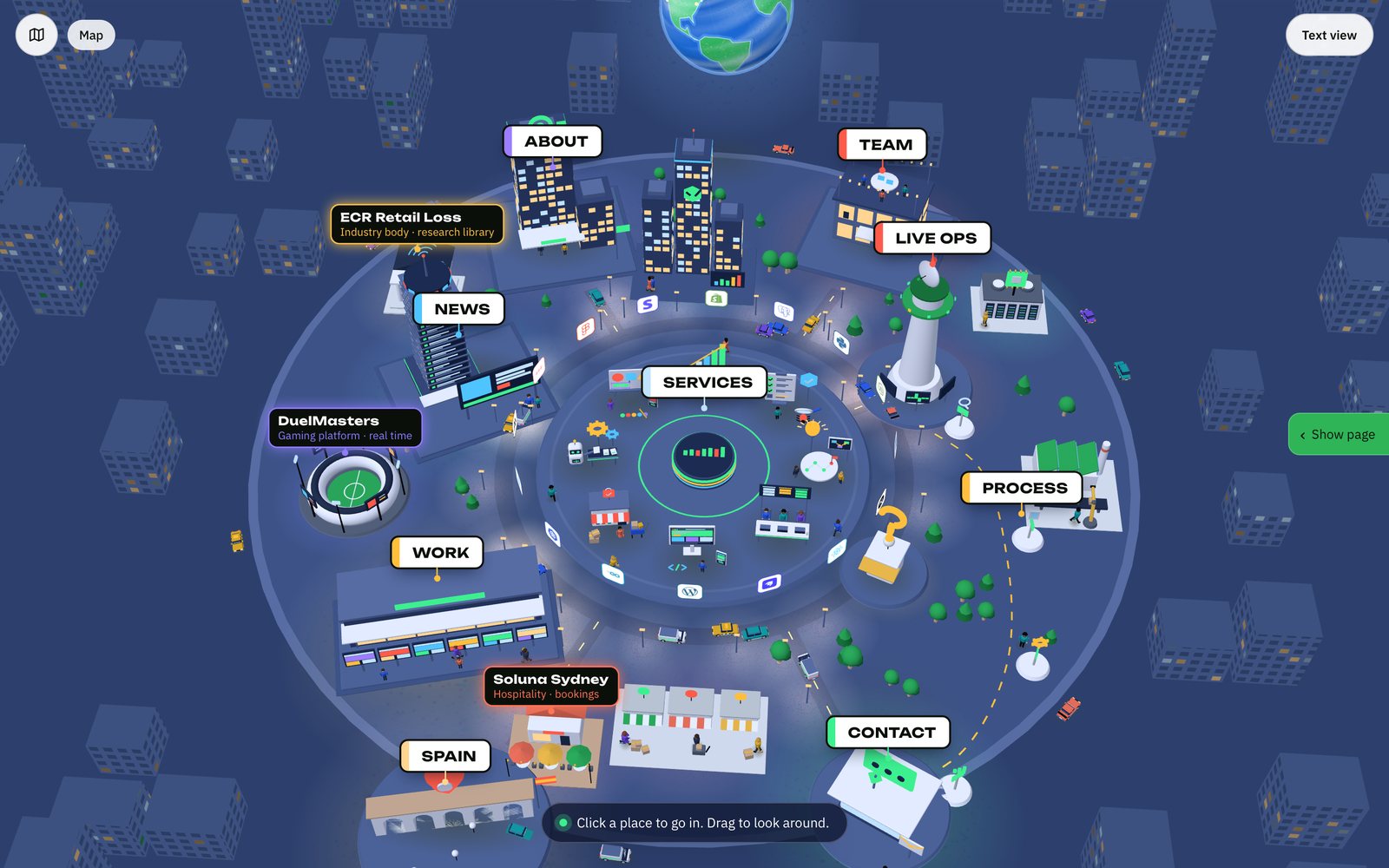
On smart-ai.es the home page is a city at dusk. About, Work, News, Team, Contact and eight services are buildings. A click flies the camera to one of them, and the page for that section opens beside the scene. News is a tower whose storeys are the articles.
Why now
Three things changed, and it took all three.
The browsers. WebGL 2 has been in every major browser since Safari 15 shipped it in September 2021. There is no plugin, nothing to install and no "best viewed in". Every current phone carries a capable graphics chip that sits idle while it renders paragraphs.
The architecture. The page and the scene can now be built as two separate things. A framework such as Next.js sends complete HTML from the server, and a library such as React Three Fiber mounts the scene on top of it afterwards. Ten years ago a 3D site was a Flash movie with a website trapped inside it. Today it is a normal website with a scene laid over it.
The cost. The expensive part of 3D was never the first draft. It was the loop: build a scene, look at it, dislike it, rebuild it. With AI-assisted development that loop is hours long. The first production release of the smart-ai.es world took four days from a written specification, and those four days included at least five rounds of art direction in which the world went from a pale island to a lit city. That is what moves 3D out of the campaign budget and into the budget of an ordinary website.
The three objections, with numbers
"It will kill our SEO"
It will, if the content lives inside the scene. A crawler reads HTML. It does not see what is drawn on a canvas, and neither does an AI assistant when it fetches a page to answer somebody's question. A site whose words exist only in 3D is, to a search engine, an empty page. We wrote about a related way to become invisible in AI crawlers blocked by bot protection.
The fix is an order of work, not a trick. The page comes first and the scene second:
- Each of the 60 addresses on smart-ai.es is a server-rendered page with its own title, headings, text, links and structured data.
- The scene is mounted after the page has loaded and the browser is idle.
- The labels in the scene are real links, so the navigation exists for a keyboard and a crawler as well as for a mouse.
- With JavaScript switched off, the whole site is still there.
Before launch a script compared every page with the release that had no 3D in it: text, links, titles and structured data. The result was 60 of 60 identical. Lighthouse scores the live site 100 for SEO.
"It will be slow"
It costs something. These are the measurements, taken on the live site:
| Measure | smart-ai.es with the 3D world |
|---|---|
| 3D code, gzipped | 244 KB, fetched after the page has loaded |
| One scene | 4 to 15 KB |
| Largest contentful paint, mobile lab | 2.6 s |
| Layout shift | 0 |
| Lighthouse performance, mobile | 88 on the home page, 90 on a service page |
| Draw calls in the busiest scene | 115, against a budget of 120 |
The Lighthouse figures are the median of three runs with mobile settings. The whole 3D layer weighs about as much as one large photograph, because the city is geometry generated in code and there are no model files to download.
The honest cost is main-thread time. Total blocking time is around 300 ms in the lab, where the plain pages measured under 25 ms, because building a city takes work even when it happens after the page is already on screen. One cold run of the six was far worse than the others. That is the number we are still bringing down, and it is the number to ask any 3D agency for, since download size is the easy one to look good on.
What keeps the rest in check is decided before any art is made: a size limit for the 3D code, a draw-call budget for every scene, scenes split into chunks so a visitor downloads only where they go, and frames drawn only when something changes, so a still scene does not drain a battery.
"It will not work on our customers' devices"
Quality is chosen by the device and not by the designer's laptop. On arrival the site checks the graphics chip and picks one of three quality levels. If the frame rate drops, the level drops with it, and it can climb back.
If WebGL 2 is missing or switched off, the visitor gets the plain site. That is decided before the first paint, so nothing flashes and nothing moves. And every visitor has a Text view button that turns the world off and remembers the choice.
We checked the live site in the Chromium and WebKit engines, which between them cover Chrome, Edge and Safari, at desktop and phone widths. The world drew, the console stayed clean and nothing scrolled sideways. Firefox and a shelf of real phones are next on our list, and we would sooner say that than write "works everywhere".
The same order of work covers accessibility. The scene is navigation, and the content stays in HTML, where a screen reader, a keyboard and the browser's own search all work. Lighthouse scores the live site 100 for accessibility.
Where 3D does not belong
A scene is a way to travel through a site. It is a poor way to read one.
- Checkout, forms and anything with a deadline. Nobody wants to fly to a payment field.
- Legal pages and documentation. Our own privacy policy has no building.
- Long reading. An article opens as text, over the scene, and the scene waits.
The rule we work to is short: the scene navigates, the HTML informs.
There is a rule for motion too, and we learned it the usual way. The first version of the city had lights pulsing on every building. After one review everything that blinked by itself came out. Motion that answers the visitor reads as craft. Motion that runs regardless reads as noise.
Seven questions before you commission one
- Can you show me a page with JavaScript switched off?
- How large is the 3D code, and when does it load?
- What does the scene do on a phone with a weak graphics chip?
- What does a visitor see when WebGL is not available?
- How do you prove the HTML did not change when the scene went in?
- Can a visitor turn the 3D off, and is the choice remembered?
- Can you turn it off in production without taking the site down?
A studio that has shipped one will answer all seven with a number or a link. A studio that has made a showreel will talk about the showreel.
What this means for 2027
Flat pages are not going away. They are becoming the layer underneath: the part a search engine reads, an assistant quotes and a screen reader speaks. What sits on top of that layer is where a site can still be told apart from the thousand others generated the same afternoon.
That is the work we take on as 3D website development: the scene, and everything that makes it safe to ship. If you have a site that already ranks and want a world on top of it without putting those rankings at risk, tell us about it.